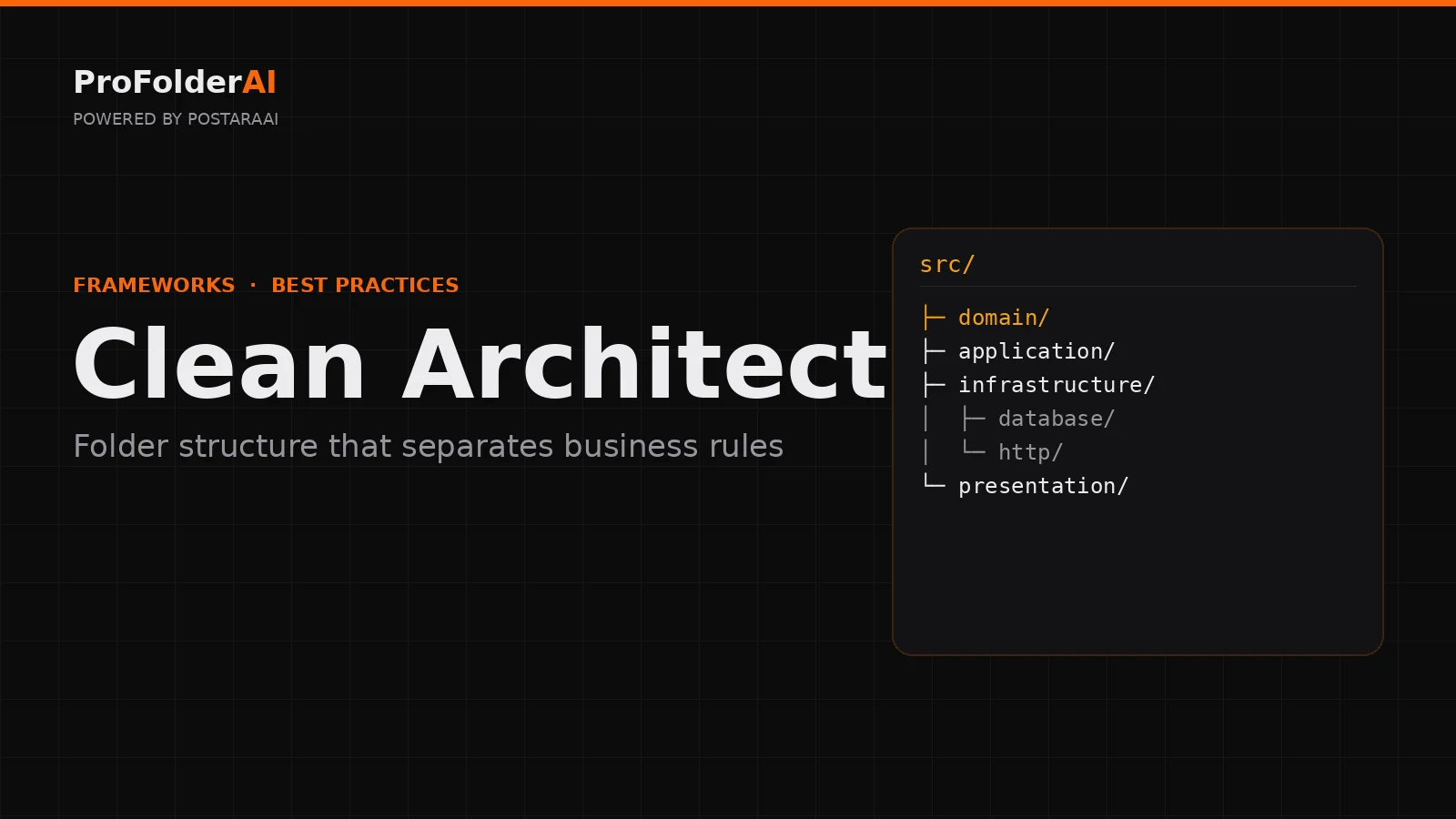
A clean architecture folder structure organises code around business rules instead of frameworks. By separating what your application does from how it does it, a clean architecture folder structure keeps the core logic independent, testable, and easy to change.
The idea, popularised by Robert C. Martin, is simple: dependencies point inward, toward your business rules. A clean architecture folder structure expresses that rule directly in how the directories are arranged.
This guide explains the clean architecture folder structure layer by layer, with a practical layout you can apply to almost any language or framework.
What Is a Clean Architecture Folder Structure?
A clean architecture folder structure separates code into layers — domain, application, infrastructure, and presentation — where inner layers hold business rules and outer layers hold details like databases and frameworks. Dependencies only point inward.
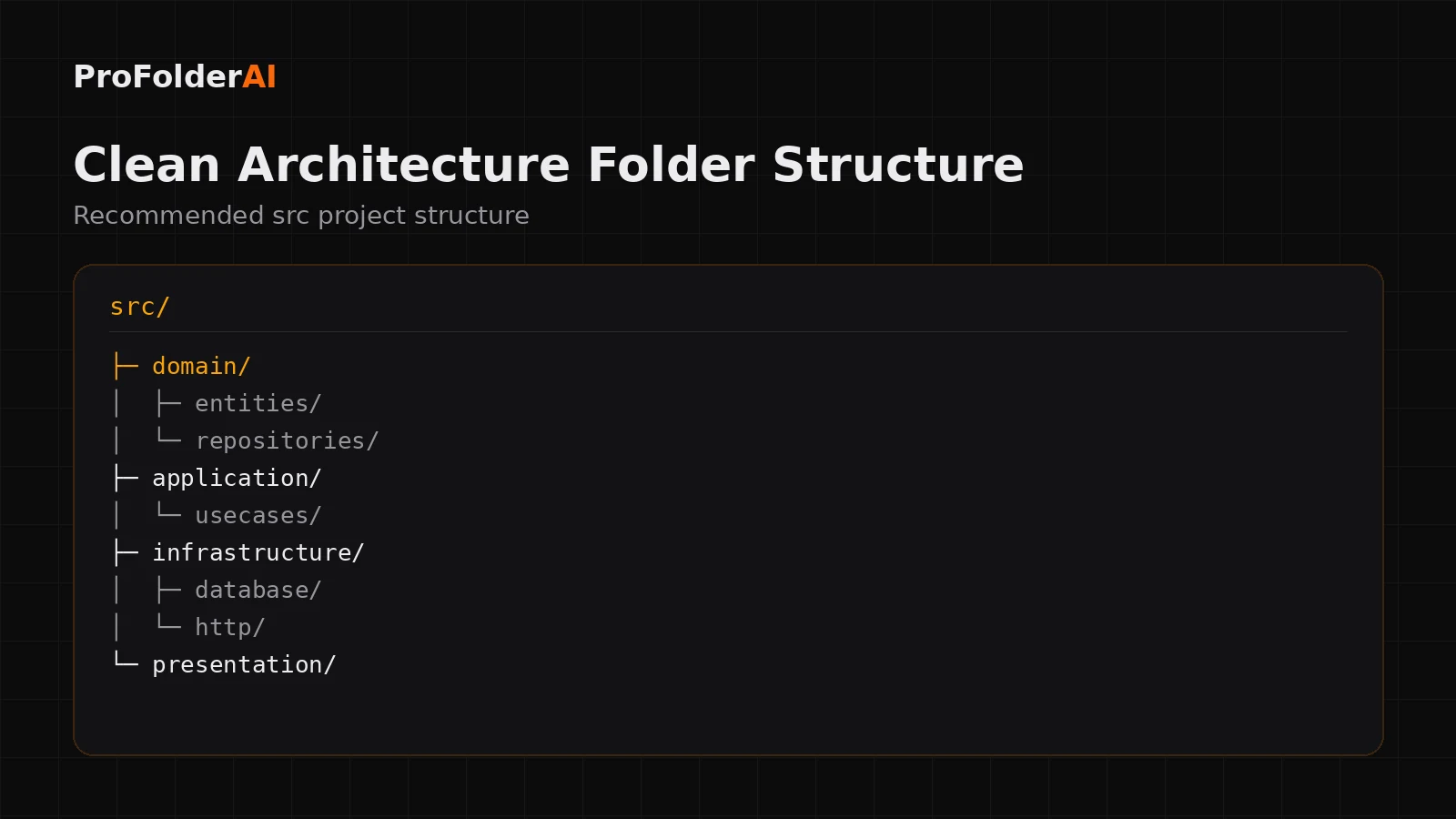
A typical clean architecture folder structure looks like this:
src/
├─ domain/
│  ├─ entities/
│  └─ repositories/
├─ application/
│  └─ usecases/
├─ infrastructure/
│  ├─ database/
│  └─ http/
└─ presentation/
Each layer of the clean architecture layout has a single responsibility and depends only on the layer beneath it.
What Does the Domain Layer Contain?
In a clean architecture layout, the domain layer holds entities and core business rules. It has no dependencies on frameworks, databases, or the web — it is the most stable part of the system.
Entities and repository interfaces live here. Because the domain sits at the centre of the clean architecture layout, it can be tested in isolation without any infrastructure.
What Is the Application Layer For?
The application layer holds use cases — the specific actions your software performs. In a clean architecture layout it orchestrates the domain to fulfil a request, without knowing about databases or HTTP.
A use case such as CreateOrder coordinates entities and repository interfaces. This layer is where the clean architecture layout turns business rules into application behaviour.
Where Do Frameworks and Databases Go?
Frameworks, databases, and external services belong in the infrastructure layer — the outermost part of a clean architecture layout. They implement the interfaces defined by the inner layers.
Keeping these details on the outside means you can swap a database or web framework without touching your business rules. That replaceability is the whole point of a clean architecture layout, and it pairs naturally with strong software architecture principles.
How Does Clean Architecture Apply to React or Node?
The same clean architecture layout applies to any stack: a Node.js API or a React app can both keep business rules in a domain layer, independent of the framework around them.
The language changes, but the layering does not. A clean architecture layout is a pattern, not a framework feature.
Common Clean architecture layout Mistakes
- Letting the domain layer import frameworks or database code
- Putting business logic in controllers or UI components
- Skipping the application layer and calling the database from the domain
- Over-applying the pattern to a tiny project that does not need it
Expert Perspective
Architecture is about the important stuff. Whatever that is.
— Ralph Johnson, Computer Scientist
A clean architecture layout keeps the important stuff — your business rules — protected at the centre of the system.
Conclusion
A clean architecture layout separates domain, application, infrastructure, and presentation so business rules stay independent of frameworks and databases. The result is software that is easier to test, change, and scale.
Apply the clean architecture layout once and the same layering will serve you across every language you work in.
Call to Action
Generate a production-ready structure for your next project instantly with ProFolderAI — describe what you are building and download a clean, ready-to-use folder tree.
Open the generator See plans & pricing →
ProFolderAI is part of PostaraAI — a suite of AI-powered tools for developers, creators, and small businesses.
About this article
- Written and maintained by the ProFolderAI team, part of PostaraAI.
- Published June 24, 2026 · Updated June 26, 2026.
- Questions or corrections? Contact the team.

Bineesh Koyente Thodika is the founder of ProFolderAI and PostaraAI. He builds AI-powered developer tools, WordPress solutions, and software products that help developers, agencies, and indie hackers launch projects faster.
Keep reading
File Structure Best Practices for Effective Project Management
Learn file structure best practices to maintain organized projects, enhancing collaboration and efficiency for developers and teams.
Folder Structure Best Practices for Developers and Teams
Discover folder structure best practices to enhance project organization. Improve collaboration and efficiency with clear guidelines.
Mastering Software Project Folder Structure for Success
Crafting a solid software project folder structure enhances organization and efficiency. Learn best practices to streamline your development workflow.