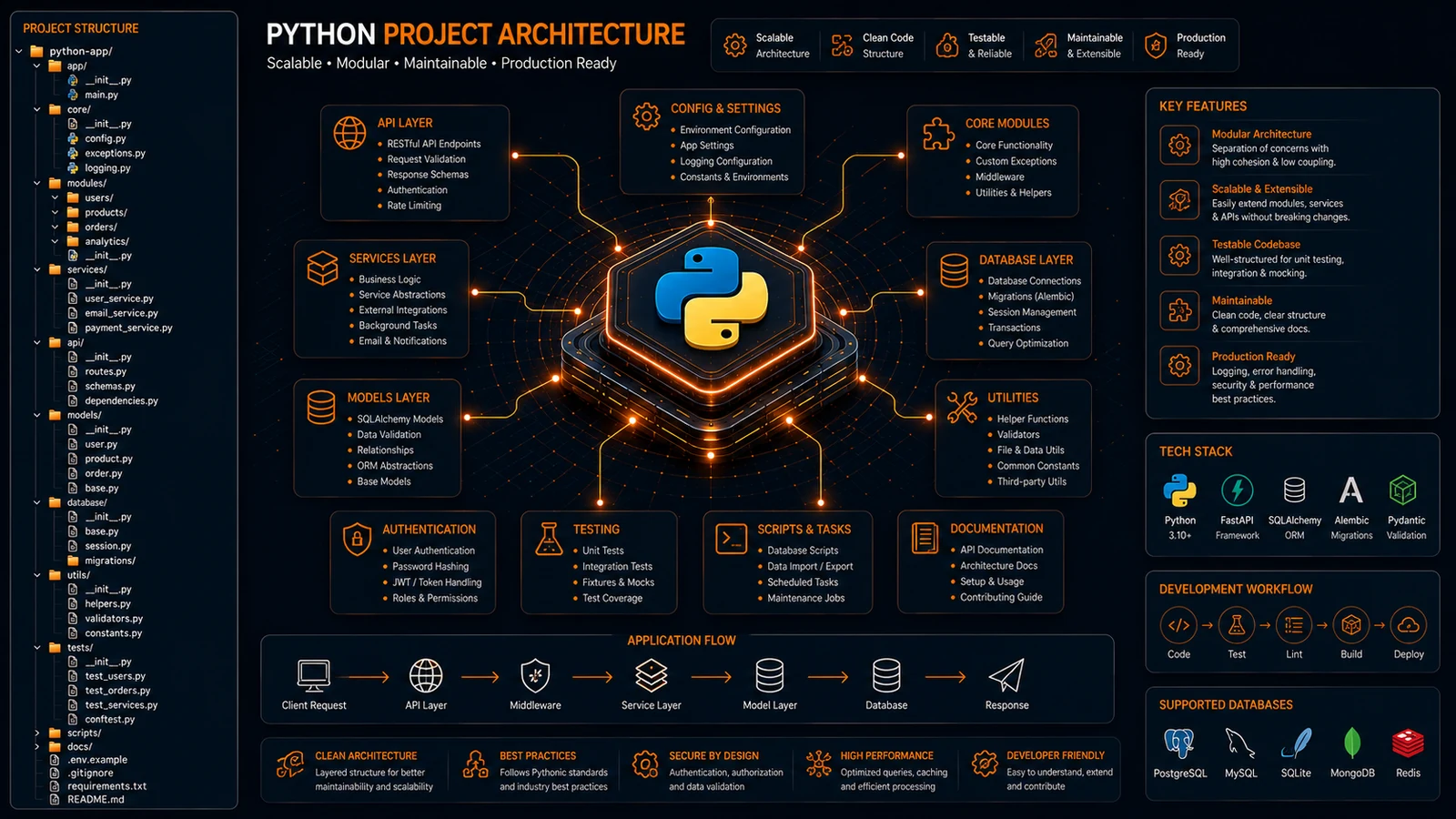
A well-organized Python project is easier to develop, maintain, test, and scale. While small scripts may work with a few files, larger applications quickly become difficult to manage without a proper structure.
As projects grow, developers often face challenges such as duplicated code, scattered business logic, confusing imports, and difficult testing workflows.
A clean Python Project Structure helps solve these issues by creating clear boundaries between application layers and improving code maintainability.
In this guide, you’ll learn the best practices for organizing Python applications, structuring modules, managing dependencies, and building scalable software projects.
Why Is Python Project Structure Important?
Python Project Structure defines how files, modules, packages, tests, and configurations are organized. A good structure improves maintainability, scalability, and developer productivity.
It helps developers understand and navigate code more efficiently.
Why It Matters
As applications grow:
- More modules are added
- Business logic expands
- Testing becomes complex
- Team collaboration increases
Without organization, projects become difficult to maintain.
Real Example
Large Python applications used by companies such as Google, Instagram, and Dropbox rely on structured architectures to support long-term growth.
What Is the Recommended Python Project Structure?
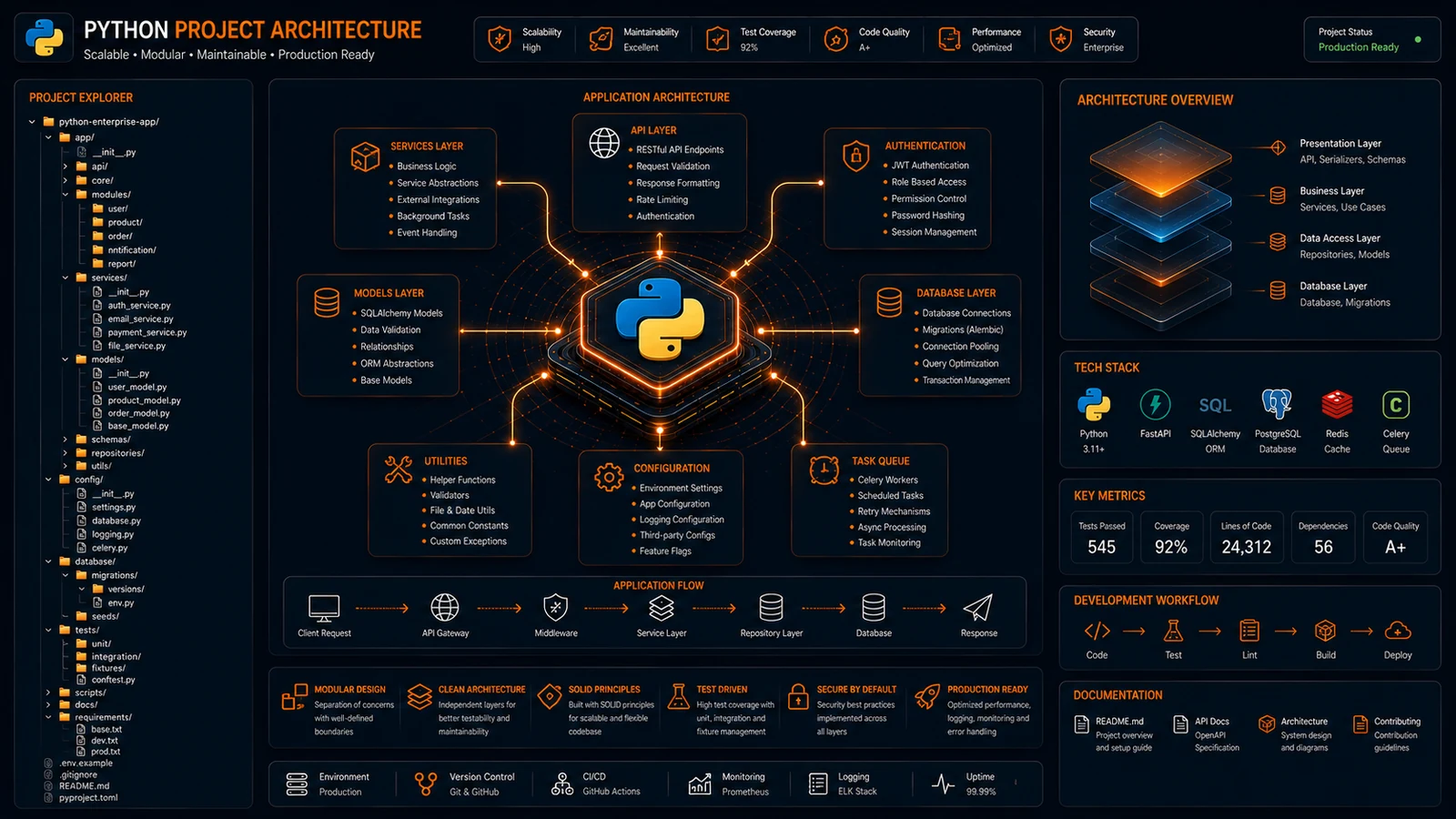
The recommended Python Project Structure separates application logic, services, models, APIs, configurations, and tests into dedicated directories.
This approach creates a scalable and maintainable architecture.
Recommended Structure
project/
├── app/
│   ├── api/
│   ├── services/
│   ├── models/
│   ├── database/
│   ├── utils/
│   └── config/
├── tests/
├── docs/
├── scripts/
├── requirements.txt
├── .env
└── README.md
Benefits
- Easier navigation
- Cleaner architecture
- Better testing
- Improved scalability
How Should Python Modules Be Organized?
Python modules should be grouped by functionality and responsibility. Related modules belong together inside dedicated packages.
Example
app/
├── users/
├── products/
├── payments/
└── notifications/
Best Practices
Group Related Features
Keep feature-specific code inside feature packages.
Use Clear Names
Choose descriptive package and module names.
Avoid Deep Nesting
Keep structures simple and predictable.
Result
Developers can locate functionality quickly and reduce confusion.
Where Should Business Logic Live?
Business logic should be stored in dedicated service modules rather than API routes or controllers.
Example Structure
services/
├── auth_service.py
├── user_service.py
├── payment_service.py
└── email_service.py
Benefits
Better Reusability
Services can be reused across multiple APIs.
Easier Testing
Business rules remain isolated.
Cleaner APIs
Routes focus on request handling.
Mini Case Study
A payment service can support subscriptions, invoices, and checkout processes without duplicating code.
How Should API Endpoints Be Organized?
API endpoints should be stored in a dedicated API directory to separate request handling from business logic.
Example
api/
├── auth.py
├── users.py
├── products.py
└── payments.py
Advantages
Cleaner Architecture
API layers remain focused on communication.
Better Maintenance
Updates are easier to manage.
Improved Scalability
New endpoints can be added without disrupting existing code.
Why Is a Dedicated Tests Directory Important?
A dedicated tests directory improves code quality by centralizing unit tests, integration tests, and automated testing workflows.
Recommended Structure
tests/
├── unit/
├── integration/
├── fixtures/
└── conftest.py
Benefits
Better Reliability
Testing catches issues early.
Easier Automation
CI/CD pipelines can execute tests efficiently.
Improved Confidence
Developers can deploy changes safely.
Industry Standard
Professional Python teams treat testing as a core part of application architecture.
How Should Configuration Files Be Managed?
Configuration files should be centralized in a dedicated config directory and environment variables should be stored separately.
Example Structure
config/
├── development.py
├── production.py
└── settings.py
Best Practices
Use Environment Variables
Store secrets outside source code.
Separate Environments
Maintain different settings for development and production.
Centralize Configuration
Keep all configuration management in one location.
Security Benefit
Sensitive information remains protected and easier to manage.
What Common Python Structure Mistakes Should You Avoid?
Common mistakes include placing everything in one folder, mixing business logic with APIs, and neglecting testing organization.
Mistake 1: Flat Structure
Avoid storing every file in the root directory.
Mistake 2: No Service Layer
Keep business logic separate from routes.
Mistake 3: Missing Tests
Testing should be part of every project.
Mistake 4: Hardcoded Configuration
Use environment variables instead.
Result
Applications remain easier to scale and maintain.
Can AI Generate Better Python Project Structures?
Yes. AI-powered project structure generators can create scalable Python architectures instantly based on project requirements and industry standards.
Benefits
Faster Setup
Generate complete project structures within seconds.
Consistency
Apply the same architecture standards across projects.
Better Planning
Start with a scalable foundation immediately.
Original Insight
Many Python developers spend significant time organizing files before writing meaningful application logic. Although project requirements vary, most successful Python applications share common structural patterns. Automating project setup removes repetitive work and allows developers to focus on solving real business problems.
Expert Perspective
Programs are meant to be read by humans and only incidentally for computers to execute.
— Donald Knuth, Computer Scientist
A clean project structure makes software easier to understand, maintain, and extend.
Conclusion
A strong Python Project Structure improves maintainability, scalability, and development efficiency. By separating APIs, services, models, configurations, and tests, developers can create applications that remain organized as they grow.
Whether you’re building web applications, APIs, automation tools, AI systems, or enterprise software, investing in architecture early reduces technical debt and accelerates development.
As Python continues to dominate modern software development, structured project organization becomes increasingly important.
Call to Action
Generate professional Python project structures instantly with ProFolderAI and start building scalable applications faster.
Open the generator See plans & pricing →
ProFolderAI is part of PostaraAI — a suite of AI-powered tools for developers, creators, and small businesses.
About this article
- Written and maintained by the ProFolderAI team, part of PostaraAI.
- Published June 14, 2026 · Updated June 24, 2026.
- Questions or corrections? Contact the team.

Bineesh Koyente Thodika is the founder of ProFolderAI and PostaraAI. He builds AI-powered developer tools, WordPress solutions, and software products that help developers, agencies, and indie hackers launch projects faster.
Keep reading
Mastering PHP Project Structure for Efficient Development
Learn how to create a clean PHP project structure that enhances maintainability and collaboration among developers.
Vue Folder Structure: Best Practices for Scalable Apps
Vue folder structure best practices for scalable apps — how to organise components, views, stores, and composables for clean, maintainable Vue projects.
Laravel Folder Structure: Best Practices for Clean Projects
Laravel folder structure best practices — how to organise controllers, models, services, and routes for clean, scalable, maintainable Laravel applications.